Buy an escalator: Can - LIFTPORTAL for shopping centres and stations
Published
When a shopping centre or station decides to buy an escalator, the conversation with us almost always starts with two questions: who will be responsible for it, and where one like it is already in operation. We get to the price later, because it cannot be calculated without a site survey. We explain why in a separate article: what affects the price of an escalator.
Who supplies it and whose equipment it is
We are the supplier and installer: PE SRBK Portal, operating under the LIFTPORTAL trademark, in business since 2002. You sign the contract with us, our crew comes to the site, and when the handrail wears out a few years later, you call us too.
The escalators are supplied under the Can - LIFTPORTAL brand. The factory we work with under this brand is located in China, and we say so straight away rather than waiting for you to read the nameplate on the machine. It makes commercial escalators for shopping and business centres, heavy-duty public transport escalators for metros and stations, and moving walks.
What our work includes
We start by inspecting the building. The engineer measures the height between floors and checks the opening in the floor slab and the route by which the truss, that is, the escalator's load-bearing structure, will be brought inside. In an existing shopping centre, this route often turns out to be the most difficult part: the escalator is delivered in large sections.
Next, we select the series and quote for the supply. Our own crew installs the escalator, commissions it and hands it over to you. We also take on maintenance after start-up.
The site survey and quote are free. We travel all over Ukraine and have an office in Ivano-Frankivsk and a branch in Lviv.
Which series goes where
The commercial series suits a shopping centre: the escalator runs during shop opening hours, and the flow of people there is uneven. Metros, stations, pedestrian underpasses and footbridges get the heavy-duty public transport series, because there the machine runs almost non-stop under a dense flow of people. For open-air entrances and crossings there is a version with protection against moisture and frost, which we agree for each project.
Steps come in widths of 600, 800 or 1000 mm, and the usual speed is 0.5 m/s. How many people such an escalator will carry is best taken not from advertising figures but from the EN 115-1 standard, which gives values specifically for planning passenger flows:
| Step width, mm | Design flow, persons per hour |
|---|---|
| 600 | 3600 |
| 800 | 4800 |
| 1000 | 6000 |
In theory a 1000 mm step carries more, but people do not stand two to every step, so designs use the figures from the table.
The inclination angle is 30 or 35 degrees. The standard allows 35 degrees for a rise of up to 6 m at a speed of up to 0.5 m/s, and the escalator is then shorter and takes up less floor area. For a greater rise, 30 degrees is used.
If people move with trolleys or suitcases, a moving walk is installed instead of an escalator: an inclined one between the floors of a hypermarket or a horizontal one in a long passage. Under the same standard, its angle does not exceed 12 degrees.
Where these escalators are already in operation
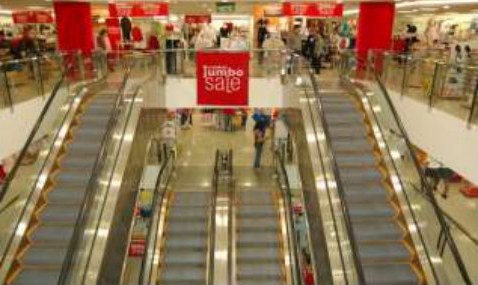
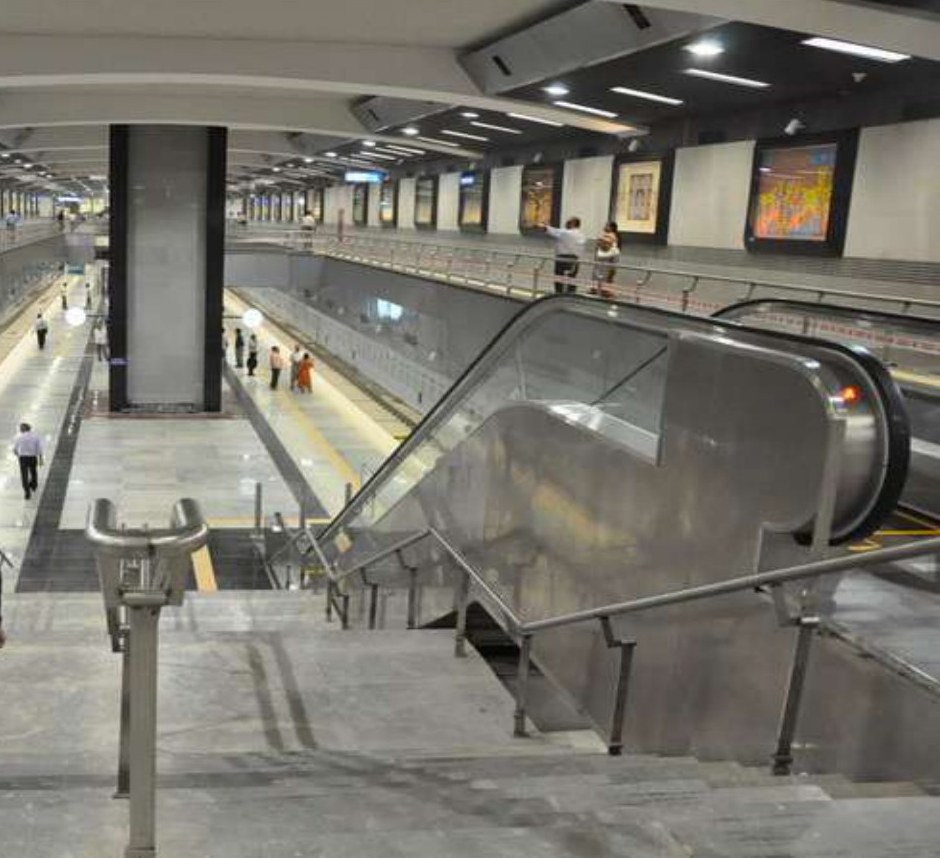
First, the manufacturer's projects. We do not claim them as ours, but the loads there are real: heavy-duty public transport escalators at metro stations in India, escalators on an open-air pedestrian bridge in Turkey, and the shopping centre in Indonesia in the photo above.
Our own work we can show you in Ivano-Frankivsk: our crew installed the six escalators at Mens shopping centre in 2021, with Izamet equipment. So installing and starting up escalators is familiar work for us.
Documents
An escalator made to DSTU EN 115-1:2019 comes with a declaration of conformity, drawn up by the manufacturer or a representative authorised by it. After installation comes the technical inspection, and the owner obtains the right to operate it, because an escalator is classed as high-risk equipment.
We show you the list of documents before the contract, so that your lawyer sees it in advance and not on the day of delivery.
How to buy an escalator
The quickest way is to call: +38 050 585-39-28. Or leave a request on the contacts page. Three things are enough to get started:
- the city and type of building;
- the height between floors or the floor levels from the drawings;
- the construction stage: design, frame or finished building.
The engineer will measure the rest on site. If the building is still being designed, tell us straight away: it is easier to include the opening and the truss supports in the drawings before the floor slabs are poured.
You can download a short brochure on Can - LIFTPORTAL escalators (PDF, 8 pages, 0.9 MB). General information on the types of escalators and moving walks and their installation is on a separate page.
Last stop: your request